The Reviews are in …Creative Writer’s Journal/Handbook

Reviews are in for my series of Journals/Handbooks for men, women, and students who WRITE!

       ‘I just got my copy and my first thought (after I need to start using this) is; What a great gift this would make for anyone who is a writer or who shows an inclination in that direction.

Trisha Sugarek gives you “permission” to scribble down ideas and not have to write the great American novel every time you put pen to paper. In the first couple of pages, she gets you going with examples and encouragement and she makes you realize that while writing is work, it’s not impossible work…in fact, it can even be fun work.

With tips for lots of different writing types and encouragement from writers across time and genres nestled in the margins, this journal encourages you to get those words down on paper.
Sure, you’ll use a computer for the final heads down working sessions to get a finished work done, but for day-to-day fun “I can do this” writing, this journal and handbook is a great motivator.’  ~~D. Johnson

and this from Midwest Book Review!

Creative Writer’s Journal and Handbook begins where so many writer’s guides should: with the basics of how to pursue a dream job as a writer. The problem with most writers’ guides is that they assume some prior degree of excellence or experience; but this handbook poses something different: the opportunity to begin with no prior skill level or experience. All that’s needed is the desire and passion to be a writer, and everything flows from there.
So if you ‘scribble’, if you like words, if your stories ‘find’ you, and if you aspire to be something more (say, a published blogger); then here’s the next step in the process. From how ideas begin to how they are nurtured and written down, there to be refined until they see the light of day (i.e. other readers), this journal offers support, insight, and ideas for jump-starting the creative process and linking it to action.

White, lined journal pages offer a workbook approach that augments white space with inspirational quotes on the process from other, successful writers. So while you’re staring at the usual journal blank pages, inspiration can spark from others’ experiences and insights.

This isn’t just about prose, either: Sugarek includes sections on different formats, from Haiku Poetry to writing a stage play. Each section offers inspirational insights into format, structure, and writing challenges – then uses the journal/quote format to encourage readers to put something down on paper.   So if it’s nuggets of information spiced with the encouragement of fresh lined, white space that is needed, Creative Writer’s Journal and Handbook offers a success formula beginners can easily absorb, all packaged in a survey that assumes no prior familiarity with writing.  ~~D. Donovan, Senior Reviewer for Midwest Book Review

and…….

‘….Before meeting and working with you, I had a very skewed view of what being a writer was. I thought you had to be independently wealthy, or somehow hypnotize the publishers into giving you a huge advance, or be a teenager still living at home, or do it on the “5pm to midnight shift” (meaning you get home from work and have no personal life).

But seeing your work, and seeing how you adapted to the web format and allowed that to become part your professional presence was a revelation. It allowed me to imagine a way where my writing would not just be for fun or some cool party trick that set me apart from the usual anti-social geeks at work, but the core of what I had to offer.

And if not for YOU, that wouldn’t have happened…’~~Leon Adato

‘This is a beautiful and sturdy book with some of the best quotes out there to motivate you to dream bigger and write better. It would make a great gift for your female friends and family. ‘ C.Strain

Purchase   

~~~~~~~~~~~~~~~~~~~~~~~~~~~~~~~~~~~~~~~~~~~~~~~~~~~~~~~~~~~~~~~~~~~~~~~~

DON’T MISS UPCOMING BLOGS featuring INTERVIEWS with  best-selling AUTHORS!

In addition to my twice weekly blog I also feature an interview with another author once a month. So come along with me; we shall sneak into these writers’ special places, be a fly on the wall and watch them create!  

To receive my posts sign up for my blog, blogs, blogger, writer, author, playwright, books, plays,fiction  On the home page, enter your email address.  Thanks!

A Journal for Men Who Want To Write….

Neon.RMWO_cover_spine_REV84_copy   Available Now!   This handsome journal/handbook was created especially for men who want to write.

  ‘Real Men Work Out…on Paper’

The spirited journal/handbook, intended specifically for men and your creative writing, offers over 275 lined, blank pages. Each section has instruction on ‘where to begin’, storytelling, how to write a play, and developing rich characters. Nestled in the margins of each page are more tips about writing and quotes from famous writers, actors, playwrights and poets. The bold and masculine cover can be carried anywhere!  Great gift idea!

Available  at www.amazon.com or your favorite book store

“I’ll Take It”….Bukowski and Me

From his later life writings and his book, “You Get so Alone at Times that it Just Makes Sense” Bukowski wrote about how he felt bukow.typwriterhe had beaten the odds….poetry gushing faster than he could write it down and grateful that he was still alive after the hard life he had lived.

I can relate….although I had been writing since my eighth grade history class (Thank you, Miss O’Connor) I certainly didn’t consider myself a ‘writer‘.  Then very late in life, (1994) I began in earnest.  Writing my first full length play. The next one came even easier….then the next one…it’s never stopped, the ideas.

Then friends who read my plays insisted that they wanted the ‘rest of the story’.  What happened to a particular character?  Did Bill ever get out of prison?  Did Monty kill Samantha?  Did Charlie make good his escape? Did Violet get her kids back? So…now I’ve written seven novels, stage plays and countless poems. Continue reading ““I’ll Take It”….Bukowski and Me”

Blogger Declares August as Charles Bukowski Month!

It’s unofficially Charles Bukowski month because this blogger has declared it so!   Who the heck is Bukowski you might be asking. In my opinion he is one of the great writers of our time.  Known for his cutting, take no prisoners, urban poetry and musings.
It’s no secret.  I am in love with the man’s poetry.  If you love ‘bad boys’ who are shot with talent, he’s the guy for you.  I read his work every day that I write….whatever his commentary is about I am inspired to be a better writer.

Bukowski’s life was horrific by most people’s standards.  He was a raging alcoholic, womanizer, gambler and bum.  He worked regular poet, wisdom, Charles Bukowskijobs only enough to keep himself in cigarettes, booze, rent (occasionally) stamps, typewriter paper and money for the race track .  My fantasy is;  oh yes I have fantasized about him….to spend a weekend with him at my cabin, deep in the forests of the Blue Ridge Mountains.  In the evenings, before a fire, we would drink whiskey neat, talk of people, past and present, swear at each other and tell stories.  We would end the nights Continue reading “Blogger Declares August as Charles Bukowski Month!”

Attention! All Writers Out There!

There’s a BLOG out there that is dedicated to the art of writing and honing your craft. Yep!  I’m talking about mine and this is a shameless promo.  You won’t be disappointed.

For three years now I have published my posts twice a week and it’s always something about being a better writer.  Once a month I interview best selling authors such as Dean Koontz, Sue Grafton, Jeffery Deaver, Sherryl Woods, Anne Gracie, CW.CoverRaymond Benson, Lee Goldberg, Charles Bukowski and dozens more.   My goal is to inspire other writers to write more, tell their stories, try writing a play, or maybe some poetry.

Sign up on my home page  and receive an email with each day’s post.  Delete it if it doesn’t interest you.  It’s that simple.  Recently I have developed a series of ‘creative writing’ journals with ‘How To’ tips and famous quotes to inspire my fellow writers.  https://www.writeratplay.com/category/a-writers-take/ Continue reading “Attention! All Writers Out There!”

Now Available! The Empowered Woman’s Journal

Boost.Cover  JUST RELEASED!!  A Journal for ALL Women

Available at:  http://www.amazon.com/s/ref=nb_sb_noss?url=search-alias%3Daps&field-keywords=empowered%2C%20sugarek  and www.writeratplay.com/shop

This spirited journal is designed to help women open their hearts and minds to
their own creative possibilities, while honing their writing craft. Whether you are a
beginner or a more experienced writer, the shelter within these pages will empower you to
write more. You will find this journal will quickly become your constant companion.

Much more than a journal for writing down your secrets, your thoughts and dreams, this handbook provides the writer with the ‘how to’s’. Over 275 of blank lined pages for your creative writing that includes tips and insightful quotes from famous authors, playwrights, poets and celebrities.


CREATIVE WRITER’S Journal and Handbook Now Available!

1.Creative.Write.BookCoverImage  Actor, director, playwright, author, Trisha Sugarek has created 305 pages of ‘How To’, Tips, Quotes, and  275 blank, lined pages for your writing.  ‘I have created this journal for writers of all genres.  Taken from my personal experience in the writing process, I hope it kick starts new writers to begin and more experience writers to continue.’

~~This spirited journal is designed to help writers open their hearts and minds. Much more than a journal for your creative writing, this handbook provides the writer with the ‘how to’s’ of writing. Tips, instructions and prompts to help you to hone your writing skill. Each blank, lined page has writing tips and quotes from other famous authors.~~

Available at www.amazon.com    

A writer is only a writer when he or she is writing. Thinking isn’t writing, research isn’t writing, doing anything other than writing isn’t writing. 

Neon.RMWO_cover_spine_REV84_copy

Available NOW!! ‘The Creative Writer’s Journal & Handbook’

CW.CoverNOW ON SALE!!!  This new, innovative Journal and Handbook.

This spirited journal is designed to help writers open their hearts and minds to their own creative possibilities, while honing their craft. Whether you are a beginner or an experienced writer, you will find this journal will quickly become your constant companion.

Much more than a journal for your creative writing, this handbook provides the writer with the ‘how to’s’ of writing. Over 275 of blank, lined pages for your creative writing that includes more tips and insightful quotes from famous authors.

What’s Inside:
“How Do I Begin?”
“How to Develop Exciting Characters”
“How to Write Fiction”
“How to Write a Stage Play”
“How to Write Poetry”
“How to Write Haiku Poetry”

You can order this Journal  here in my book store or go to Amazon.com

Teachers and Students:  Go to Facebook and  Like’ this page if you think this is something you would like to own.  Future special offers to educators and students.


How To Write A Play…9 Tips


Ideas have come to me
in the visiting area of a state prison, a haunted lighthouse, my days in Hollywood, or listening to stories of my mother, growing up with 13 siblings ….. the ideas come to me in a little kernel of truth and I am inspired to write.

I am frequently asked ‘how can you be so prolific?’,  and ‘how do you write so many plays?’ ‘where do you get your ideas?’

So I thought what a perfect time to give my readers nine tips about writing their first stage play.  After all, 45 play scripts ago and seventeen years earlier I began writing my first play script.  And that led me to create the Creative Writers’ Journals and Handbooks which include ‘how to write a play’ and ‘how to create exciting characters.’ I went on to create a book of writing tips. 

        NINE TIPS TO GET YOU STARTED  … and more 

all journals & plays available at amazon.com

1.  Format is very important.    If you submit your new play to anyone they will not read it if it is not in the proper format. There is software out there that offers auto-format but I found them lacking.   The character’s name is centered. Blocking (action) is indented and placed in parentheses. Setting (indent once), Rise 

 (indent once) the Dialogue is far left. Double space between the character’s name and the first line of dialogue.  Blocking (action): is placed below the character’s name in parentheses. (indent x 3).  A ‘beat’ is a dramatic pause to enhance the pace of the speech and is placed in the dialogue where you wish the actor to pause for a beat or two. Or you might want to buy a play script from a publisher.  Concord Theatricals used to be Samuel French and is still the best. It seems little has changed except the name.

2. Each page represents approximately one minute of time on stage.  So if you have a play that is 200 pages long, that won’t work.  Audiences aren’t going to sit for more than one and a half hours unless you are providing a circus, a fire drill, sex, and an earthquake.  Audiences are even reluctant to sit through “The Iceman for Cometh” a classic by Eugene O’Neill.  full-length to 3 hours. You should keep your full-length script to about 100 pages which equals 1.6 hours of stage time.  For a one-act divide that by 2.  For a ten minute play your script should be from 10-15 pages. These times and figures are debated by others but this has been my experience as an actor/director/writer.

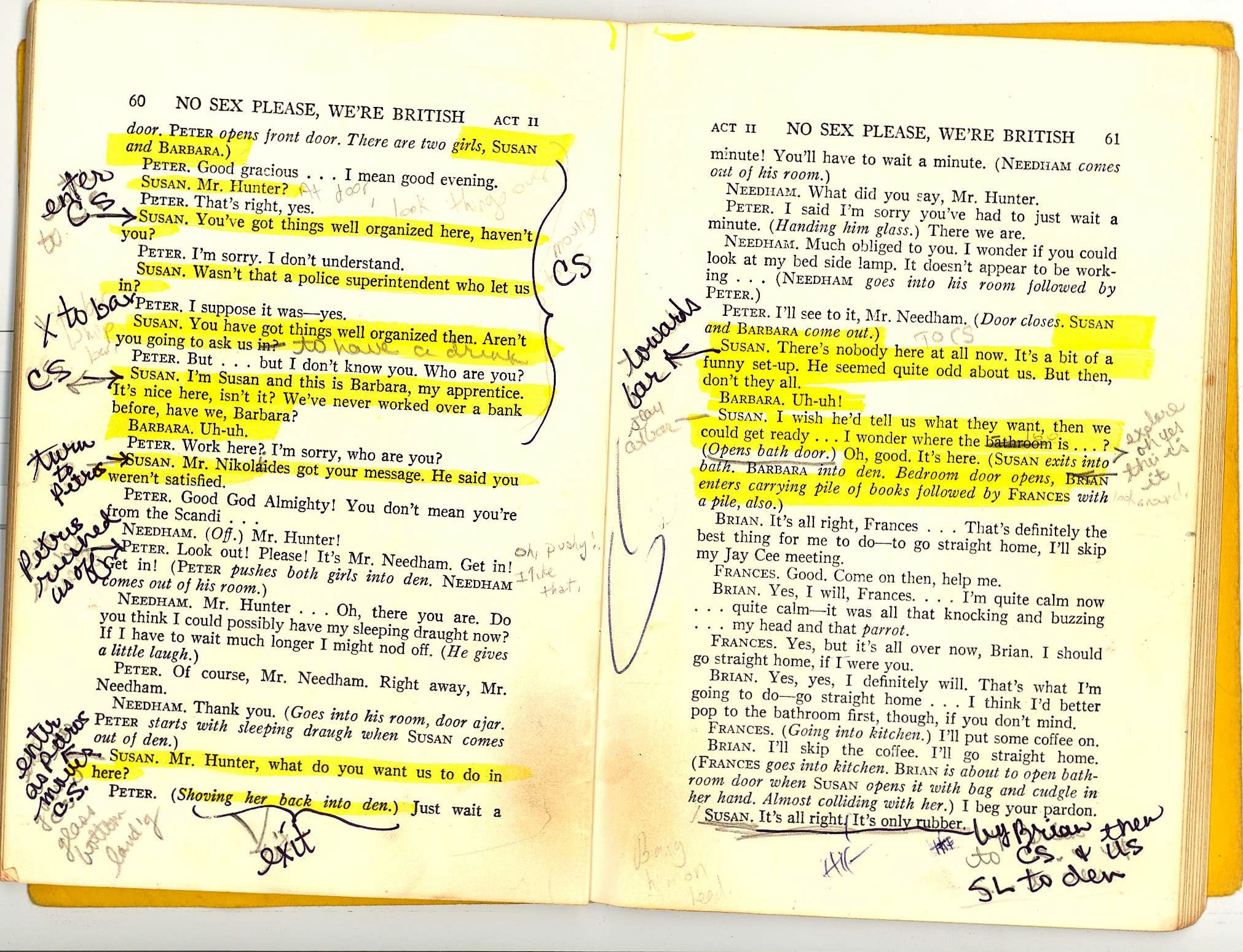
3.  Leave lots of white space on the page.  One day when your play is being produced, actors will need a place to make notes in the script during rehearsal.  This is a sample of an actor’s (mine) working script. The    how to write a play, Trisha Sugaek, inspiration, actor usually ‘highlights’ their lines and writes the director’s blocking in the margins. (in pencil, as blocking frequently changes)

4.  The blocking is indented, in parentheses, and directly below the character’s name.  This is where the playwright gives the characters instructions on when and where to move.  But, keep it short and sweet.  Remember there will be a director who has their ideas of where he/she wants the actors to be.  Be aware of costume changes in your writing.  An actor can’t exit stage left and enter stage right, seconds later, if you haven’t written in the time it will take for them to accomplish a costume change.

5.  Your script has to work on a stage If your story takes place in more than one locale, you have to be aware of the logistics of set changes. So keep it simple to start.  If you are ambitious in your setting buy a book on set design to research if your set is feasible.  Some wonderful ‘envelope’ set designs unfold when you need to change the scene.  But you have to consider the budget; would a theatre have the money to build it? Always a worry.

6.  Dialogue: Now here’s the sometimes hard part:  everything you want the audience to know about the story and the characters, is conveyed in the dialogue.  Unlike a short story or a novel, where you can write as much description as you’d like, a play script has none of that.  No description.  Here is a Sample.Dialogue.Sugarek of dialogue demonstrating how to move the story forward.

7. The ‘Arc’ of your story: The Oxford English Dictionary defines a story arc as ‘(in a novel, play, or movie) the development or resolution of the narrative or principal theme’.  Story arcs are the overall shape of rising and falling tension or emotion in a story. This rise and fall are created via plot and character development. 

Simpler Examples: In Parkland Requiem the ‘arc’ of my story is when the teacher leaves the safety of his classroom to reconnoiter the position of the shooter.

In My Planet, Your Planet, Our Planet the ‘arc’ is when the activist students march in a worldwide March defying all the rules of the school.

8. How To Know When to Change Scenes. When there is a date/time or character/scene change is a good guide. But be careful, if the time/day changes and there is a costume change needed, always remember the audience isn’t a patient creature and they will not sit and wait for very long.  A director can and will set up an area backstage for those quick changes and often the costume mistress will be there to help with shoes, zippers, etc. To save time, you should write the actor entering from the same side as they exited (when possible) to save the time it would take for them to hurry to the other side of the stage.

9. Your play should have a conflict. Your main character should have a conflict that he or she must solve quickly. No conflict = no play. Say you want to write your first play about you and your siblings growing up. That’s easy; have them argue about something. Be certain there is a resolution before your play ends.  Imagine you want to write a love story between two people. There must be a conflict somewhere in the love story. 

Did you miss my post about Publishers?

How to Format your novel

~~~~~~~~~~~~~~~~~~~~~~~~~~~~~~~~~~~~~~~~~~~~~~~~~

Journals by Trisha Sugarek
Want to see some original plays? Click here.
47 Short Plays to choose from. Click here.
                                               Fiction by Trisha Sugarek
                                               Children’s Books by Sugarek

Want to try writing a ten-minute play? Click here
How to Create Tantalizing Book Covers
Do you need help Formatting a Novel? 

~~~~~~~~~~~~~~~~~~~~~~~~~~~~~~~~~~~~
Instruction on:
How To Begin
How to Write a Play
Formatting your Play on the Page
How to write Dialogue
How to Create Rich, Exciting Characters
Stage Terminology

Purchase NOW. Click here

  ‘How To’  Journals and Handbooks for all of your Creative Writing, including how to write a stage Play! 
275 blank, lined pages for your writing.  Tips and famous quotes from authors, playwrights, directors, actors, writers, and poets to help inspire you.  Look Inside

WANT TO LEARN MORE?? … These new Journals/Handbooks offer a total of 14 points of ‘how to’.
 Available on Amazon.com    B&N, and all fine book stores.

If you’d like to try writing a ten-minute play?  Click here
How To Format a Screenplay
How to Format Your Novel
How to Format a Stage Play

  Order here

This new, exciting, instructional book is a sharing of over twenty+ years of experience. This writer has honed  her craft of creative writing and ‘is still learning.’ 

Thirty-five writing tips that include:
That first, all-important, sentence
How to develop rich characters
Writer’s Block
Procrastination
Writing process
What Not to Do (when receiving a critique)

 Takes the ‘scary’ out of writing!

(MORE)
~~~~~~~~~~~~~~~~~~~~~~~~~~~~~~~~~~~~~~~~~~~~~~~

DON’T MISS my  blog, blogs, blogger, writer, author, playwright, books, plays,fictionwith weekly posts.  Also featuring INTERVIEWS with other best-selling AUTHORS! with me once a month. We shall sneak into these writers’ special places, be a fly on the wall and watch them create!  

 To Purchase

Interview with Author, Susan Elia MacNeal

        interviews, author quotes   Do other writers find themselves  at 4 in the afternoon, still in their pajamas, lost in their writing ?   Hopefully it only happens at home and not at the corner coffee shop…

My readers are enjoying hearing about other authors writing processes.  I created a Question & Answer-type Interview and then began contacting some of my favorite authors to ask them to participate.  It turns out that not only do these other writers want to share their writing life with us, but they are equally interested in the stories from other authors.

                              In this three-part post, my interview is with Susan Elia MacNeal.   I am especially honored as Susan and her publicist have asked me to review her next book, “His Majesty’s Hope”, to be released in May of His_Majesty's[1]this year.  Please sit back and enjoy a chat with Susan……..


Q. Where do you write? Do you have a special room, shed, barn, special space for your writing?

A. I work in my beautiful library, with floor-to-ceiling bookshelves, overstuffed velvet sofas, a fireplace, two cats, and a handsome young manservant to fetch me tea and coffee.  Okay, that’s not true. But I do have two cats.  I live in New York, and space is definitely at a premium. Before our son was born, my husband and I used our guest bedroom as an office. After it became a kid’s room, I started working at the kitchen table, or sometimes cross-legged on the living room sofa.

I joined the New York Writers Room in the West Village for a while and had many happy days there with a view of the Empire State building, but I’m not currently working there. (My son has asthma, and I like being closer to his school in case of emergencies.)  I also love a little café near us—best coffee in the world, plus big tables full of other writers. I also like to work at our local public library, which is one of the old Carnegie libraries.

I’ve also written at a lot of friends’ homes, while they’ve been on vacation – some of them famous. So, parts of my books have been written at actor/writer John Hodgman’s apartment (I also looked after their cat), composer Kristin Andersen Lopez and Robert Lopez’s apartment (yes, of course I picked up his Tony award for Avenue Q and pretended to make an acceptance speech), and Ron Lieber and Jodi Kantor’s apartment. (They’re both journalists for the New York Times, and Jodi’s the author of The Obamas.)

I’ve also written with Josh Axelrad, the author of Repeat Until Rich, which was fun, because we’d break for bourbon at six p.m. But he was always saying, “I’m afraid you’re listening to me not typing and thinking I’m lazy!” I tried to tell him I have too many of my own issues to even thinking about listening to his typing or not typing!

Susan_Elia_(c)_Lesley_Semmelhack              The most amazing place I’ve ever written was just recently at Arisaig House, which is a former manor house, now a bed and breakfast, on the west coast of Scotland. It was also used as an SOE spy training camp during World War II. I was talking to a lot of people alive and living in the area during that period of time, and doing research, but I also wrote in a beautiful room with oriental rugs, a crackling fire, a view of the grounds and shoreline, and three big napping golden labs. Heaven!

But I’ve also written on trains planes and waiting rooms. Basically, I’ve learned to write anywhere and everywhere.

http://www.susaneliamacneal.com/

~~~~~~~~~~~~~~~~~~~~~~~~~~~~~~~~~~~~~~~~~~~~~~~~~~~~~~~~~~~~~~~~~~~~~~~~~~~~~~~~~~~~

Join us to read part two of this wonderful interview (March 7th.) with best-seller author Susan Elia MacNeal .
~~~~~~~~~~~~~~~~~~~~~~~~~~~~~~~~~~~~~~~~~~~~~~~~~~~~~~~~~~~~~~~~~~~~~~~~~~~~~~~~

Start your month off right!! DON’T MISS UPCOMING BLOGS. A NEW SERIES, “The Writer’s Corner” INTERVIEWS with other  best-selling AUTHORS!

I have had a wonderful response from other authors and plan on featuring an interview once a month .  I have invited such luminaries as: Anne Purser, Dean Koontz, Sheryl Woods, Jo-Ann Mapson, Robert McCammon, Susan Elia MacNeal, Mark Childress, Sue Grafton, Jeffrey Deaver, Rhys Bowen, Elizabeth Gilbert, Amber Winckler, Walter Mosley, Nora Roberts, and many others.

So come along with me; we shall sneak into these writers’ special places, be a fly on the wall and watch them create!
~~~~~~~~~~~~~~~~~~~~~~~~~~~~~~~~~~~~~~~~~~~~~~~~~~~~~~~~~~~~~~~~~~~~~~~~
To receive my posts sign up for my blog, blogs, blogger, writer, author, playwright, books, plays,fiction Go to the home page; On the right side you’ll see a box where you can enter your email address. Click on “join my blog”.  You need to confirm in an email from ‘Writer at Play’ .  Thanks!